
Many beginners struggle with practicing singing at home. Relying on yourself isn't easy, and singers are often simply unsure how to proceed. In my experience, they need a practice plan, and they need a bit of support.
What if there was a way to make practicing less of a chore and more of a fun, productive experience?
I'll give you a plan for practicing at home without feeling overwhelmed. A clear system is the key to motivation. Knowing what to do, and in what order, gives you peace of mind that you're doing the right thing, and it gives you results.
By the way, also check out my larger, step-by-step guide to learning how to sing. This practice advice is one of the steps in it.
How to practice singing at home (quick steps)
- Loosen the body and posture.
- 5–10 minutes of gradual warm-up.
- Drill one technique on one or two song phrases.
- Assess, then scale that technique up.
- Sing through for joy and performance.
- Stop if you strain, and resume later. Aim for 4–6 days a week, 15–60 minutes depending on your level.
Note: this is a guide to practice singing with a song you already know, and developing your voice in general. I also have a guide for you on how to learn a song. Of course, practicing at home is embedded in a bigger picture of learning how to sing.
1. How often should you practice singing at home?
More is not always better when it comes to voice practice. Our vocal cords are like other muscles in some ways: they need training over time. But unlike other muscles, for most of us they have far less endurance.
There's only so much you should sing in a day. If you practiced piano or violin, your teacher might tell you to put in up to eight hours a day. If we did that to our vocal cords… I don't even want to think about it.
That said, different students at different levels need different plans. I've heard teachers recommend an hour of singing a day. I beg to differ. It might be right for some, but not for all.
Practice should be regular, because we're dealing with muscle memory: we want to replace bad habits with good ones. But does that mean every single day? Some would say yes. I say at least one day off a week. Most athletes follow that rule too. Your muscles need at least a day to restore. Every other day works very well also.
How often, in short
Anything between 4 and 6 times a week I'd call regular.
As long as you're in a good period, with nothing heavy that means taking things slow, the closer you get to 6 times a week, the better your progress.
"Hundreds of studies have shown that spaced practice, also called distributed learning, helps people learn better and retain what they learn for longer than cramming."
The University of Arizona
What are your singing dreams and obstacles?
Answer the questions, and schedule a free exploration call
The more detailed your answers, the better I will be able to help you
2. How long to practice singing?
And now for what I think is the more important question: how long should each session be?
Beginners: how long to practice
If you're starting out, your muscles aren't used to singing, and they're not yet familiar with singing right. On top of that, you might not be able to tell whether you're doing it right. So keep practice short, to avoid drilling in wrong technique. I usually recommend around 15 minutes of singing for beginners.
Later I'll lay out the full structure, which involves more than just singing, so it's fine to give 15 minutes to the singing itself and extra time to the rest.
Intermediate singers: how long to practice
If you've got some lessons under your belt, you can tell when you're straining, so you can go longer without much risk. Say 30 to 40 minutes, depending on how your throat feels.
General rules for session length
Once you're in the session, pay attention. Mind your throat above all, how it feels. Is it hard to sing? Are you straining? Notice it while you sing and after each phrase. If you feel effort, use a technique you've learned to correct it. If that doesn't work after a few tries, stop. Switch exercise or song. If it's still no good, come back in a few hours, or another day.
Advanced singers: how long to practice
You can practice for a full hour. Some people happily go longer. If you must, and you're sure your voice is doing fine, go ahead, but I wouldn't recommend it. Even the best of us fall into the trap of overdoing it. Regularity matters more than the length of any one session.
Data intermezzo: the psychology of why we (don't) practice singing
I have to address this, because it's so common. Singers carry internal hurdles that keep them from practicing at home.
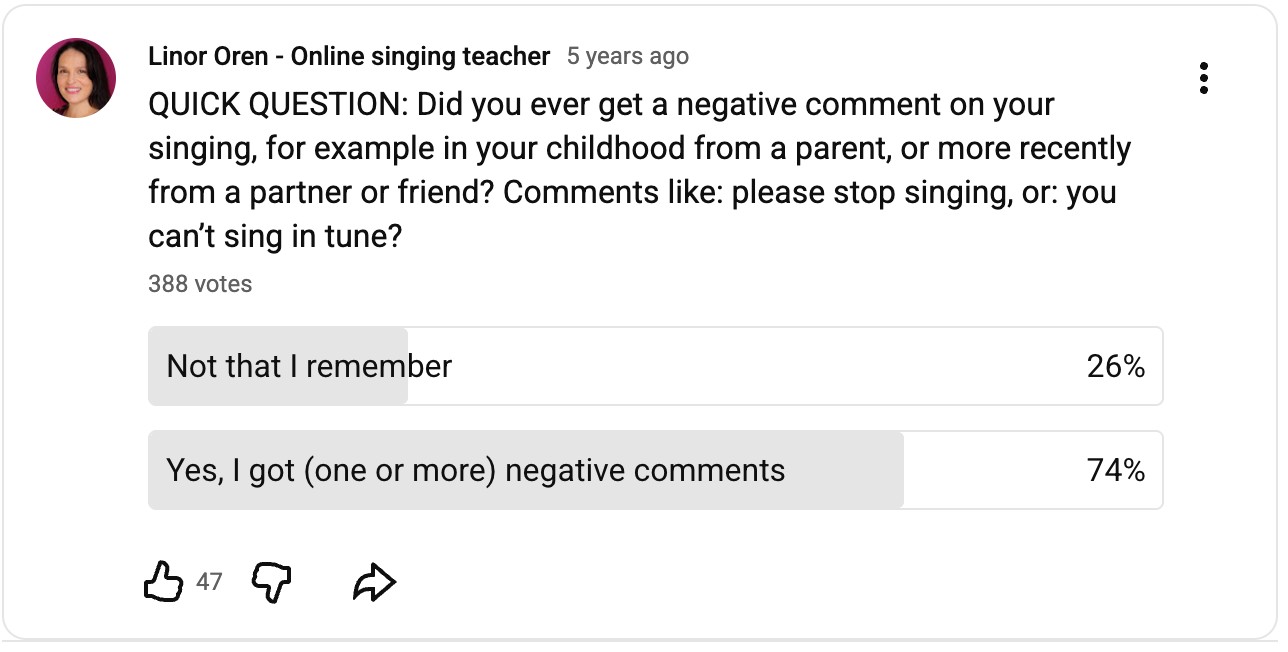
I ran two large polls on my YouTube channel. For most people, the struggle isn't a lack of talent. It's historical feedback and current environment.
Hurdle 1. The ‘ghost’ in the practice room: childhood feedback. I asked my YouTube community about the feedback they got about their voice growing up. The results were striking:
- 74% of respondents (out of 388) reported negative or discouraging feedback about their singing in their formative years.
- The impact: three out of four singers walking into their living room to practice are mentally battling a ‘ghost’ from their past, a teacher, parent or peer who once told them they weren't good enough.
Hurdle 2. The practical barrier: what stops you? When we asked singers their number-one obstacle to consistent home practice, the answer wasn't ‘lack of time’ or ‘exercises too hard.’
- 86% of singers (out of 79 votes) named mental blocks and fear of being heard by others as the thing holding them back.
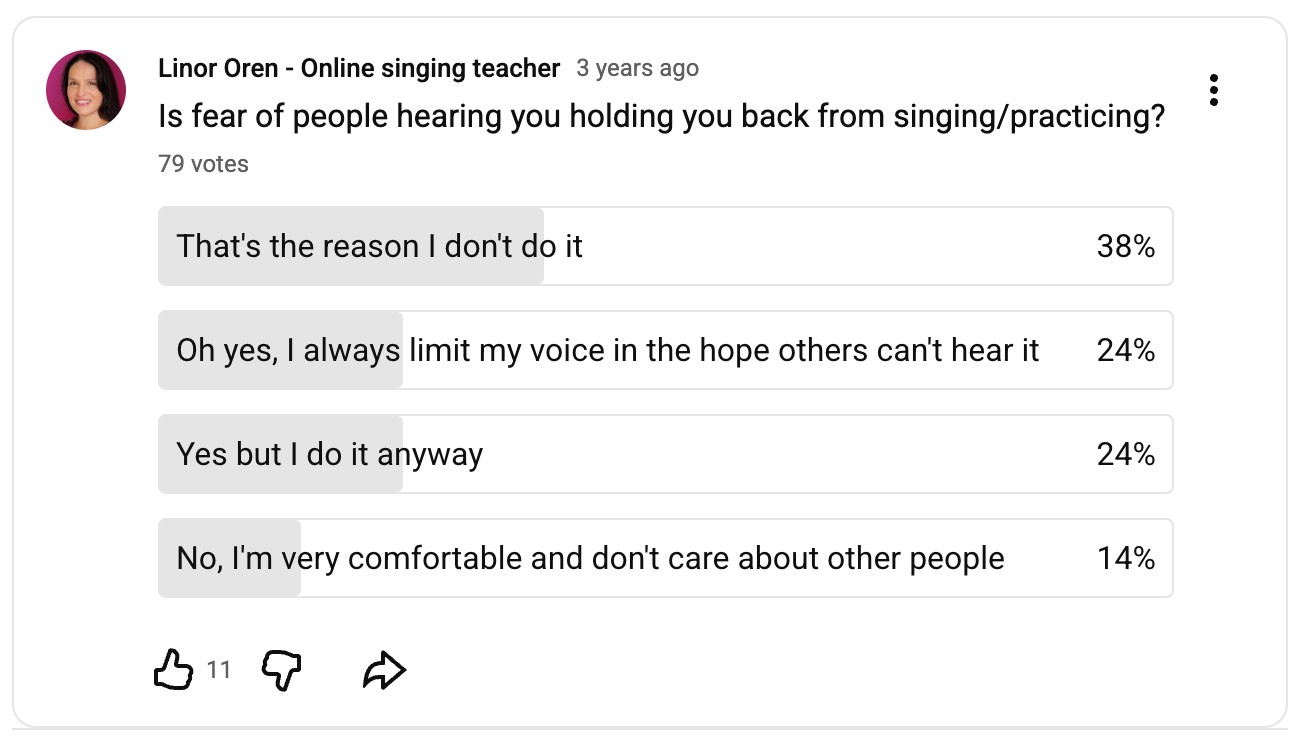
Why this matters: the hurdles to practicing are largely psychological. If you feel stuck at home, you're not failing at technique. You're probably part of the 86% dealing with the mental weight, or the 74% who were discouraged as children. To improve your home practice, deal with the ‘mental volume’ before the physical volume.
A tip from left field: get over the nerves in front of an AI.
Sergey Kuhne, founder of Singing Carrots, built an AI Vocal Coach that gives you exercises and analyses your pitch. The irony is that singing in front of a computer can take the stage fright away. Read more about the future of AI and voice coaching.
Case study: how to deal with your 'fear of the neighbors'
In my podcast episode ‘From Scared to ADDICTED,’ my student Emiliya talks openly about how the thought of her neighbours used to keep her voice small. Before our work together, she'd only sing at home when she was sure no one could hear, because she was ‘always shy about it’ and worried about ‘not bothering other people.’
She used to put other people's comfort ahead of her own enjoyment, essentially putting her passion on hold so as not to be a nuisance. Her transformation was about moving past that fear. By the end of our chat, she describes herself as ‘addicted’ to making the very loud sounds she once feared her neighbours would judge.
By the end of our discussion, she describes herself as being "addicted" to making the very loud sounds she once feared her neighbors would judge!
How to practice singing when you're worried about being heard
If the data above is you, here's the practical part. You don't have to wait until you feel brave. You can start today, quietly, and build from there.
First, the quiet tools. Hums, lip trills and the NG sound (as in ‘tongue’) barely carry through a wall. They're almost silent, yet your vocal cords are still waking up and learning to work well. So you can do real, useful practice without anyone hearing a thing.
Then, when you want to actually let your full voice out, there's the Blanket Hack. Grab a pillow or, even better, a bundled-up blanket, hold it against your face, and sing full-out into it. It takes the volume down by around 90%. I've sung full opera into a blanket in masterclasses and the people in the room could barely hear me. You do have to lift it off to breathe between phrases, so you'll look a little unhinged, but your vocal cords won't mind. It lets you practice being loud and free without any of it reaching the outside world. Perfect for late nights, or early mornings before the house is awake.
There's a hidden bonus too. With the sound muffled, you can't rely on your ears, so you start paying attention to what you feel instead: the vibrations, the throat, the air. Feel it, don't listen to it is one of the most important habits in singing, and the blanket teaches it by accident.
Have the talk. If you live with people, sit them down and tell them what you're up to. Don't apologise for it. Something like: ‘I'm working on my voice, I'll be making some odd noises in there, it's all part of the plan, don't call the police.’ You set the terms. You have a right to sing in your own home. That's not a metaphor, it's literally true.
And if a neighbour ever complains? Take it as a backhanded compliment. It means your voice was powerful enough to travel through a wall. Be kind about it, find a time that suits everyone, and keep singing anyway.
One last challenge, and it matters. Every time you practice, spend a little while, even thirty seconds, singing without the blanket. It'll feel uncomfortable, and that's fine. Tell yourself: I get to do this. Bit by bit, thirty seconds becomes a minute, then two, and the fear gets smaller every time.
3. What are the different parts of a singing practice?
Now for what I consider the heart of how to practice: what should the session actually be like? Mostly, people go about this wrong. We walk in and start the chaos: sing, get unhappy with the sound, try again, get lost, attempt five things at once, and on it goes.

Me, when I used to practice wrong
I'll go out on a limb: this won't get you far, fast. It wastes your time, and it piles blockages onto a task that's already not easy.
Positive thinking and productivity go hand in hand. If you're like me, a phrase like ‘positive thinking’ might sound a bit new-age and raise an eyebrow. But it's actually very practical. So here are a few things to understand about how voice training really works.

Advice for my 21-year-old me
If I could go back about 20 years and give myself advice, well, it would be a lot of advice. I made many mistakes, especially with my singing. But one crucial thing I could have said: practice should not be a burden.
As a twenty-something I'd have been sceptical of that. So being handed a formula I could run every time I practiced would have been a game changer. I'd have seen the results myself, and that would have kept me going. That's what I'm hoping to do for you.

"
“Practice shouldn't feel like punishment. Once you have a simple system to follow, it stops being a chore, and you start to actually see yourself improve.”
My formula for a productive, fun practice session
1. Start with a bodywork routine.
This is crucial. Get the body loose, with a nice posture, before you start.
The routine can change over time, depending on what your body needs: a short yoga, Pilates or Alexander session, or a few sun salutations.
2. Warm up.
Like any athlete starts with basic movements, so should we. Use my warm-up exercises, or any you like.
3. Practice on a song.
Do one or two phrases at a time, and focus on one technical element at a time. There's much more on combining elements in my Make Singing Click Club, and we'll go into it a bit more below too.
4. Sing through at least for a few minutes.
Also crucial. Remember, don't think only about technique. Just sing. Sing for the joy, think of the lyrics and the music, do some performance exercises, come what may. It reminds you why you're doing this.
If you're not sure what to sing, pick something forgiving. Here are my easy songs to practise with.
Whatever you do, please don't skip steps 1 and 4. They're the best way to keep anxiety and mental strain out of your practice.
What are your singing dreams and obstacles?
Answer the questions, and schedule a free exploration call
The more detailed your answers, the better I will be able to help you
4. Coaching yourself in singing practice
How often have you heard ‘You just have to practice. Practice makes perfect. Practice, practice, practice’? It'll apparently get you to Carnegie Hall. Yeah, yeah, but how? Practice shouldn't be random, like throwing darts blindfolded and occasionally hitting the board.
Start with a bright spot, not a problem
Before you drill anything, a quick mindset shift that changes everything. Most of us practice by hunting for what's wrong and trying to fix it. That's exhausting, and it's slow.
There's a famous story about tackling child malnutrition in Vietnam. Instead of attacking the problem head-on, researchers looked for the families whose kids were healthy despite the same hard conditions, and asked what those families were doing differently. Then they spread those few habits around. They multiplied what already worked.
We do the same with your voice. Instead of asking ‘what's wrong with this,’ catch a moment that suddenly feels good, easy, free, even for a second, and pay close attention. What did your body just do? Where did the air go? Where did you feel the vibration? That good moment is your bright spot. Your job is to repeat it and multiply it. Then you drill it in, like this:
Drill it into your system
So to show you exactly how you get better at something, What I mentioned earlier is what I call “drill it into your system”.
- 1Choose one technical thing you've learned, from your teacher, a YouTube tutorial, wherever. For example: relax your jaw.
- 2Sing an exercise, or one or two phrases from a song, without pausing.
- 3Rate your performance on that one thing only. Give it a number from 1 to 10. I recommend going under 5. I'll explain why.
- 4Pick a higher number for next time, maybe double it. If you gave yourself a 3, aim for a 6. You'll probably land somewhere along the way on the next try. That's how you get better.
Be harsh on yourself, only at the ranking stage. Give yourself a lower score rather than a higher one. If you say ‘that was an 8 or a 9,’ you're really saying ‘I can't do much better than that,’ which is harsh and negative. Give yourself a 5, and the potential 10 gets exciting. I can't wait to hear that 10.
Nuala felt her voice was restricted and didn't understand why. Through the program she gained clarity, structure, and rediscovered the freedom in her singing, like when she was a child.
What about more than one thing? Build a Machine
Once you've drilled in one thing, you'll naturally want to add a second. Say you've got the jaw relaxed, and now you want to expand your ribs too. The trouble is, the moment you think about both, you drop one of them. We're just not good at juggling.
So instead of multitasking, you build what I call a Machine: two drilled-in things rolled into a single thought, so you only ever hold one idea in your head.
The neat way to do it is to find one image that contains both. If you're relaxing the jaw and expanding the ribs, picture something that does both at once. Or split it across your breath: do the first thing as you inhale, the second as you start the sound. Either way, you end up doing both while only thinking of one. Then you rank it, scale it up and drill it in, exactly as before. That's how singing stops feeling like spinning ten plates.
5. Get regular feedback from your vocal coach
Going to a lesson once every two or three weeks won't give you the consistency you need. In my experience, many students struggle to practice regularly. It's nothing to be ashamed of, it's human. We like to work and learn alongside others.
So between lessons, arrange to stay in touch with your teacher, simply online. Send small video clips of a phrase or an exercise.
1. Motivation and encouragement
Learning to sing is a long journey and it's easy to get discouraged. A coach gives you technical feedback and emotional support. I personally nudge my students now and then on WhatsApp: ‘What are you practicing today?’
2. Preventing bad habits
Without guidance, you start second-guessing whether you're applying a technique correctly. Regular check-ins catch mistakes before they set in, which matters for long-term vocal health.
3 Faster improvement
A coach spots things you might not notice, so instead of spending weeks figuring it out alone, you make targeted adjustments and get better results in less time.
In short, while self-practice is important, staying connected with a vocal coach ensures that a singer stays on the right track, remains motivated, and reaches their full potential faster and more safely.
Orion struggled with self-criticism and overthinking, which affected his voice. I helped him build a structured, personalised approach so he could sing naturally, confidently, and without holding back.
Conclusion
Let me make it concise:
- Practice regularly, 4 to 6 times a week. Regularity beats length.
- Use the 4-part structure, and don't skip starting with bodywork and ending with a sing-through.
- Focus on one technique element until you get it.
- If you can, get online feedback from your teacher between lessons.
That's it in a nutshell. Do this, and you'll handle whatever a teacher or YouTube throws at you, and make satisfying progress with your voice.
Frequently Asked Questions
How often should I practice singing at home?
Aim for 4 to 6 days a week. Consistency matters more than duration. Taking at least one rest day helps your vocal cords recover, just like athletes give their muscles time to heal. Regular, spaced practice builds muscle memory and steady progress.
How long should a singing practice session last?
Beginners can start with about 15 minutes of focused singing and gradually extend to 30–60 minutes as technique and endurance improve. Always listen to your body. If your throat feels strained, stop and rest—quality matters more than time spent.
What should a good home practice session include?
Four parts: bodywork to release tension and improve posture, a vocal warm-up, focused technical work on one or two phrases, and singing through for joy and expression. This structure keeps practice safe, productive and enjoyable.
Can you teach yourself to sing at home?
Yes, to a point. With a clear structure (bodywork, warm-up, focused technique, then singing through) you can make real progress on your own. The catch is that it's hard to judge your own voice, so most people improve faster with occasional feedback from a teacher, even just short video clips between lessons.
Is it okay to practice singing every day?
You can, but take at least one day off a week. Your vocal cords are muscles and they need rest to recover, just like an athlete's. Four to six shorter sessions a week, with a rest day, beats singing hard every single day. Regularity matters more than length.
How can I practice singing without my neighbours or family hearing?
Start with quiet tools like humming and lip trills, which barely carry. When you want your full voice, use the Blanket Hack: sing into a bundled blanket or pillow held to your face, which drops the volume by about 90%. And remember, you have every right to sing in your own home.
Why does my singing sometimes sound worse when I practice?
That's normal, especially early on. Learning a new vocal habit means it works sometimes and not others until it settles, and you have to be willing to sound rough while you explore. It's not a sign you're failing. It's a sign you're actually changing something.
No longer a little mouse...
Maybe you feel it's time to stop shushing your own voice and take your desire to sing seriously. My weekly 'Belting Mouse' mail shows you how. It gets you on track with stories and insights from my life as a singer and that of my students.

For 'little mice' who are tired of squeaking and want to start belting...